This non-promotional medical education website has been developed by AstraZeneca and is intended for healthcare professionals outside of the US.

Think Aldo Logo
  • Home
  • Expert Network
  • Foundations of Aldosterone
    • Foundations of Aldosterone
    • What is Driving Difficult-to-Control Hypertension?
    • Aldosterone Pathophysiology: Mechanisms and Clinical Consequences
    • A Deep Dive into Aldosterone Dysregulation and its Impact
  • Scientific Resource Library
  • FAQs
  • Home
  • Expert Network
  • Foundations of Aldosterone
    • Foundations of Aldosterone
    • What is Driving Difficult-to-Control
      Hypertension?
    • Aldosterone Pathophysiology:
    • A Deep Dive into Aldosterone
  • Scientific Resource Library
  • FAQs


What is Driving Difficult-to-Control Hypertension?

This module outlines the global burden of hypertension and also describes the persistent challenge of uncontrolled and difficult-to-control hypertension. It introduces the complex, multifactorial pathophysiology of blood pressure dysregulation and highlights aldosterone as a key contributor to hypertension that is difficult to control.
Developed in collaboration with:
Jiguang Wang, Alta Schutte, Krzysztof Narkiewicz and Anand Vaidya
Rate this module
Download Summary Slides

In this module, we will be covering the following...

Click a topic to jump to the section

  • The Growing Global Burden of Hypertension
  • Challenges of Uncontrolled Hypertension
  • Consequences of Uncontrolled Hypertension
  • Complex Pathophysiology of Hypertension
  • Aldosterone: Adaptive and Maladaptive Roles
  • Aldosterone and Hypertension Risk
Start Exploring

The Growing Global Burden of Hypertension

Hypertension affects more than 1.4 billion adults worldwide.1,2 Despite the availability of treatment options, hypertension remains common and usually uncontrolled (defined as ≥140/90 mmHg),2 and is associated
with increased mortality and significant cardiovascular3 and kidney4 complications.
Compared with normotension, treated but uncontrolled hypertension (≥140/90 mmHg) is associated with:3

~1.6-fold

increase in all-cause mortality

~3-fold

increase in cerebrovascular-
specific mortality

~2-fold

increase in heart disease-specific mortality

~2-fold

increase in cardiovascular disease (CVD)-specific mortality
Beyond this, hypertension is also linked to adverse kidney outcomes, including:
~67% increase in chronic kidney disease (CKD)-specific mortality between 1990 and 2021.4
Hypertension leads to hypertension-mediated organ damage and is consequently a major risk factor for
CVD and CKD progression, contributing to a reduced estimated glomerular filtration rate and higher levels of albuminuria.5–8
Cardiovascular diseases, including hypertension, led to global economic losses estimated at $3.7 trillion between 2011–2025, representing roughly 2% of GDP (Gross Domestic Product) of low- and middle-income countries.2

Challenges of Uncontrolled Hypertension

Despite available therapies, as of 2024 around 80% of hypertension cases globally remained uncontrolled.1,2 Uncontrolled hypertension is persistently elevated blood pressure (≥140/90 mmHg) that remains above
target levels despite treatment or lack of adequate management.2,3,9 This may also be due to other factors like poor adherence, suboptimal treatment, white coat effect or secondary causes, but does not meet strict criteria for true resistant hypertension.1,2,9,10 This reflects persistent gaps across the care pathway: almost
half of individuals with hypertension are undiagnosed, less than half receive treatment, and of those
treated, many still remain uncontrolled.1,2
A recent real-world evidence study of over 240,000 patients with hypertension found that 37% to 75% of patients did not achieve target blood pressure, despite taking two or more antihypertensive medications (blood pressure targets US: 130/80 mmHg; UK, Spain and Israel: 140/90 mmHg).11,a Such rates of
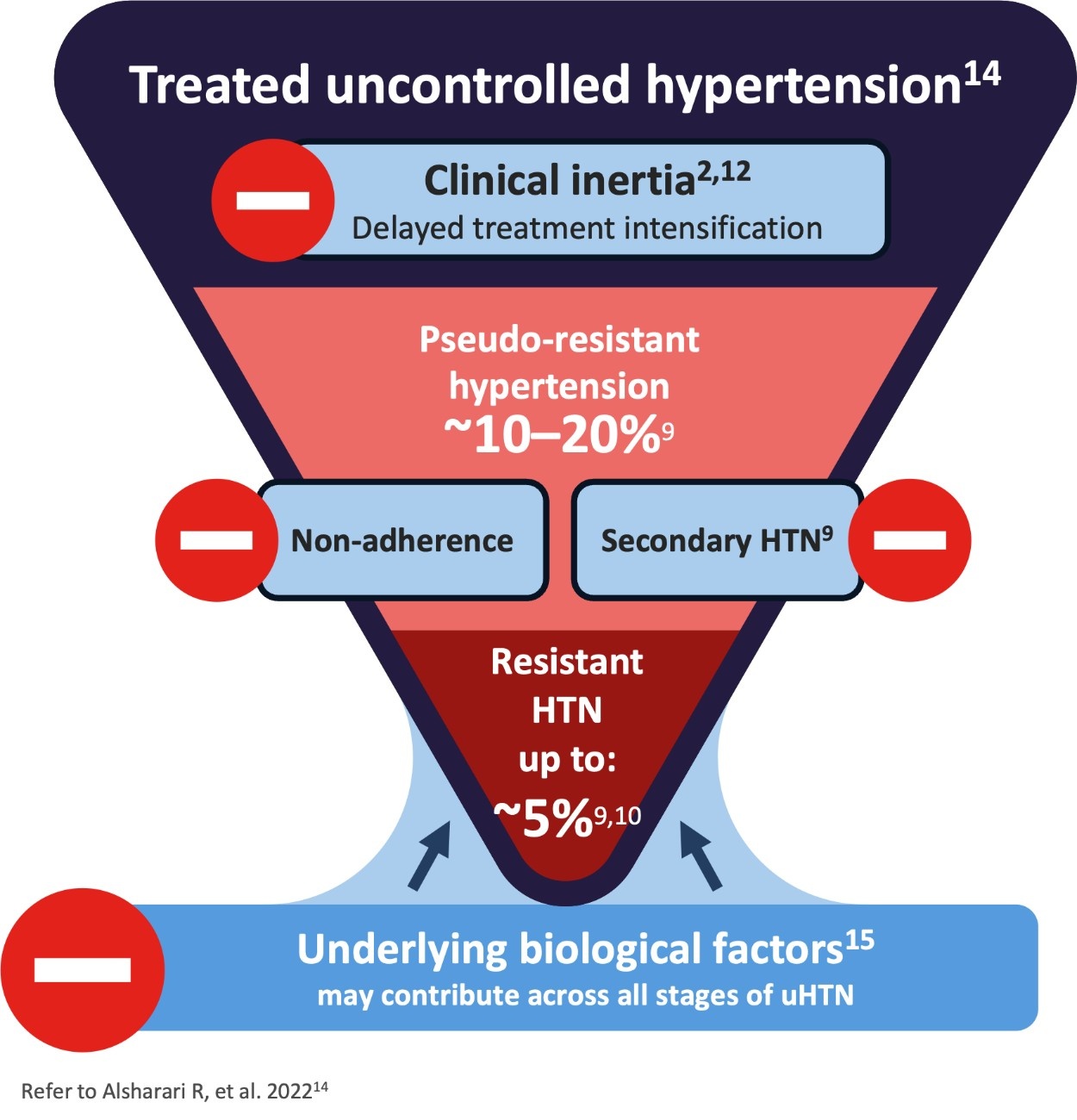
uncontrolled hypertension could stem from several factors (Figure 1):
Types Of Difficult-to-Control Hypertension Infographic

Figure 1. Types of difficult-to-control hypertension2,9,10,12,14,15

HTN, hypertension; uHTN, uncontrolled HTN

Clinical inertia
Defined as delayed treatment initiation, or inadequate therapy intensification that contributes to the high rates of treated yet uncontrolled hypertension.2,12
Pseudo-resistant hypertension
Uncontrolled blood pressure that mimics resistant hypertension but results from non-adherence to therapy or the presence of secondary causes.9
Resistant hypertension
Persistent high blood pressure
≥140/90 mmHg despite lifestyle changes and optimal treatment with three antihypertensive drugs of different classes (including a diuretic). These uncontrolled blood pressure values must be confirmed by out-of-office measurements.13

Figure 1. Types of difficult-to-control hypertension2,9,10,12,14,15

HTN, hypertension; uHTN, uncontrolled HTN

Clinical inertia contributes towards the high rates of treated uncontrolled hypertension globally.2 In the US for example, it is reported that only 1 in 4 adults with hypertension have their hypertension under control. While many patients are already receiving antihypertensive therapy, treatment intensity is often insufficient: an estimated 33 million adults may require dose escalation or
additional medications to achieve blood pressure control, and more than half of these individuals (~19 million) have a blood pressure of
≥140/90 mmHg.16 In addition to under-intensification among treated patients, many patients with
diagnosed hypertension are not treated at all. Around 35 million US adults who are recommended antihypertensive therapy remain untreated, with nearly two-thirds presenting with a blood pressure of
≥140/90 mmHg. Together, these data highlight both under-treatment and under-intensification as major contributors to uncontrolled hypertension.16
Even when appropriate therapies are prescribed, long-term blood pressure control may be hindered by
poor adherence. Side effects, complex regimens and pill burden, and the largely asymptomatic nature of hypertension may make it difficult for patients to recognise the ongoing importance of therapy, increasing the risk of premature treatment discontinuation. Adherence is further influenced by cost and access
barriers, psychosocial and cultural factors, and broader social determinants of health. In parallel, lifestyle factors such as high sodium intake, obesity and chronic stress can reduce treatment effectiveness, even among adherent patients.2
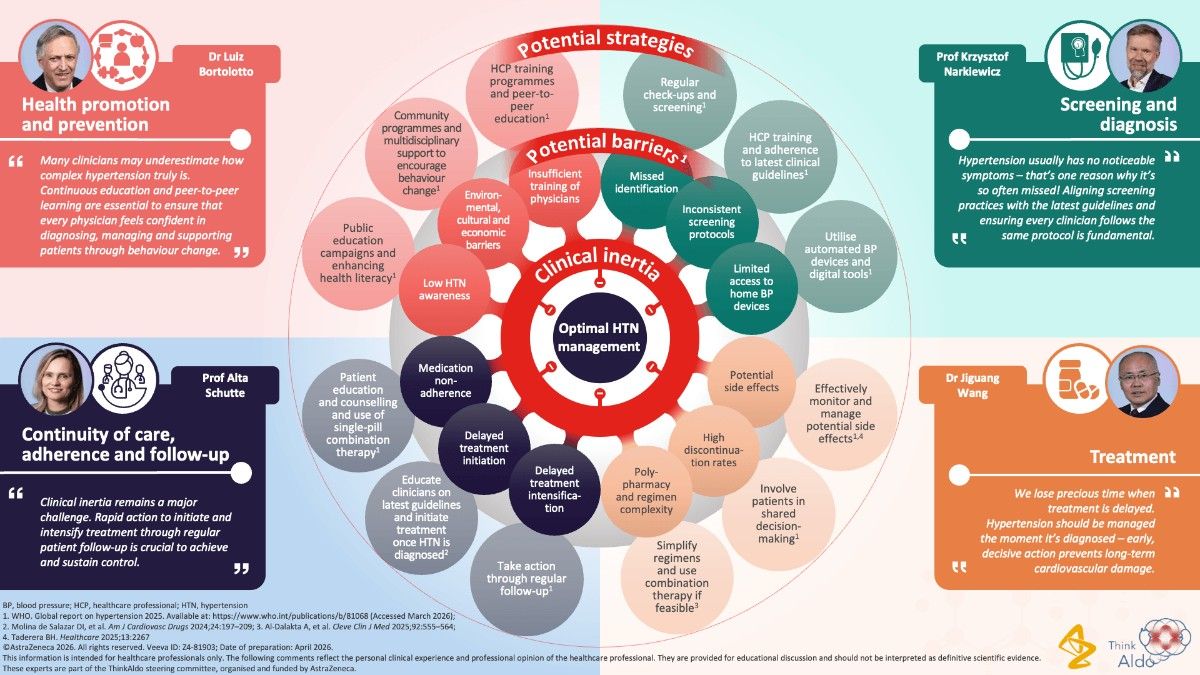
Explore the image (Figure 2) below for insights from the experts on the key barriers contributing to clinical inertia and how they may be overcome in routine practice.
Overcoming Barriers To Optimal Hypertension Management Infographic

Figure 2. Overcoming barriers to optimal hypertension management2,17–19

Recent real-world evidence from Israel, Spain, the UK and the US shows that inadequately controlled patients received similar medications and experienced similar rates of treatment intensification to those
who were controlled, suggesting that clinical inertia and adherence might not tell the full story.20,b Furthermore, underlying pathophysiological mechanisms likely contribute to the persistence of elevated blood pressure and the development of, and the challenges in managing, difficult-to-control hypertension.21

WATCH

Optimising Hypertension Management: Best Practice in Australia
Find out how Professor Alta Schutte’s work in the National Taskforce of Australia is improving the management of hypertension.


WATCH

Optimising Hypertension Management: Best Practice in Poland
Hear Professor Krzysztof Narkiewicz share best practice approaches in hypertension care in Poland.

The Clinical Consequences of Uncontrolled Hypertension

Hypertension that is difficult to control is associated with a substantially increased risk of adverse clinical outcomes. In a large multinational, observational cohort study of more than 240,000 patients treated with
≥2 antihypertensive agents, patients with inadequately controlled hypertension had a significantly higher risk of cardiovascular and kidney events compared with those whose blood pressure was controlled. Within the
US cohort of this study, the 41,994 patients with hypertension were found to have:11,b

78%

increased risk of myocardial infarction

117%

higher risk of stroke

150%

increase in transient ischaemic attack

>2-fold

increase in the risk of end-stage
kidney disease
A similar burden is seen in patients with resistant hypertension, defined as a systolic blood pressure of ≥140 mmHg and/or diastolic blood pressure of ≥90 mmHg despite treatment with ≥3 antihypertensive drugs, or the use of ≥4 antihypertensive agents regardless of blood pressure control.22 Real-world data show that patients with resistant hypertension have a markedly higher risk of adverse outcomes, including heart failure, ischaemic heart disease, chronic kidney failure, cardiovascular
events and death, compared with individuals with non-resistant hypertension.22,c
These findings underscore the need to better understand the underlying pathophysiological mechanisms that drive hypertension that is difficult to control.

Complex Pathophysiology of Hypertension

Hypertension arises from the disruption of multiple, interconnected physiological pathways that work together to maintain blood pressure homeostasis. Renal mechanisms and chronic activation of the renin–angiotensin–aldosterone system promote sodium and volume retention, shifting the pressure–natriuresis relationship and increasing blood pressure. Heightened sympathetic nervous system activity further elevates blood pressure through vasoconstriction, increased cardiac output, chronic arterial wall damage and stiffness, and altered renal sodium handling, and is commonly observed in conditions such as CKD, obesity and obstructive sleep apnoea. Additional hormonal influences, including endothelin-1, natriuretic peptides and sex hormones, interact with vascular dysfunction and remodelling to increase peripheral resistance and sustain hypertension.9,13
Physiological mechanisms such as vasoconstriction, sodium and fluid retention, sympathetic nervous system activation and renin–angiotensin system activity are targeted by current therapies, including calcium channel blockers, diuretics, beta blockers, angiotensin-converting enzyme inhibitors or angiotensin II receptor blockers, and mineralocorticoid receptor antagonists.9,23
However, one key driver remains largely under-recognised and unaddressed by existing care pathways: inappropriate aldosterone production.9,13

Aldosterone Maintains Fluid and Electrolyte Homeostasis, But Can Be Maladaptive in the Context of Modern High Sodium Diets


WATCH

Why Can Aldosterone’s Role be Pathological in Modern-Day
Humans?
Join Dr Anand Vaidya as he discusses how aldosterone’s evolutionary role in fluid and electrolyte balance becomes maladaptive in today’s high-salt environment, where even mild excess can be inappropriate and increase cardiovascular and kidney risk.

Aldosterone plays a central role in the physiological regulation of blood pressure by maintaining fluid and electrolyte homeostasis.24
Through its actions on the kidney, aldosterone promotes sodium retention, potassium excretion and intravascular volume expansion – adaptive responses that are essential for survival in environments where sodium availability is limited24 (aldosterone’s role as a critical regulator of homeostasis is explored further in Module 2).
Importantly, elevated aldosterone levels are not inherently pathological. Aldosterone does not inevitably lead to hypertension when its secretion is in response to a low dietary sodium intake and/or hypovolaemia. This is illustrated by human hunter-gatherer populations living under conditions of extreme dietary sodium restriction. For example, the Yanomamo people of the Amazon rainforest traditionally consume an exceptionally low sodium diet and exhibit markedly elevated circulating renin and aldosterone levels, far exceeding reference ranges used in Western populations, yet do not develop hypertension. In this context, this renin-dependent hyperaldosteronism represents an adaptive and appropriate homeostatic response rather than a driver of disease.25
Modern industrialised societies are characterised by high sodium intake, with the global mean sodium
intake of adults more than double the World Health Organization’s recommendation for adults (<5 g salt or <2000 mg sodium per day).26 Under normal circumstances, increased dietary sodium intake should suppress renin and aldosterone, helping maintain sodium balance and limit blood pressure elevation.27 However,
when aldosterone levels remain inappropriately high relative to sodium intake, this can drive hypertension and promote end-organ injury.28 So in the context of high dietary sodium intake, rather than serving a protective role, aldosterone can contribute to the development of hypertension and its complications.24,25
When aldosterone levels are discordant with physiological needs, excess hormone activity can exert deleterious effects across multiple target organs. Beyond its role in sodium and fluid retention, aldosterone promotes vascular dysfunction, inflammation, fibrosis, and adverse cardiac and kidney remodelling. These effects contribute not only to blood pressure-dependent damage, but also to blood pressure-independent cardiovascular and kidney risk29,30 (learn more about aldosterone as a driver of end-organ damage in
Module 2).
In this way, aldosterone’s impact is highly context dependent. A hormone that evolved to preserve circulatory stability under conditions of scarcity has become, in the setting of modern sodium-rich diets, a key driver of hypertension.24,25
Watch the video above to hear Dr Vaidya explain how aldosterone evolved to regulate fluid and electrolyte balance, and why this adaptive system can become maladaptive in today’s high sodium environment.

Aldosterone as a Driver of Increased Blood Pressure and Hypertension Risk

Multiple lines of evidence demonstrate a direct, dose-dependent relationship between aldosterone levels and blood pressure. After adjustment for potential confounders, higher serum aldosterone concentrations have been shown to correlate linearly with both systolic and diastolic blood pressure, with every 100 pg/mL (0.001 ng/dL) increase in aldosterone associated with meaningful increases in blood pressure.31,d Higher
aldosterone levels are also associated with an increased risk of rising blood pressure categories and
new-onset hypertension.
Framingham Offspring Study
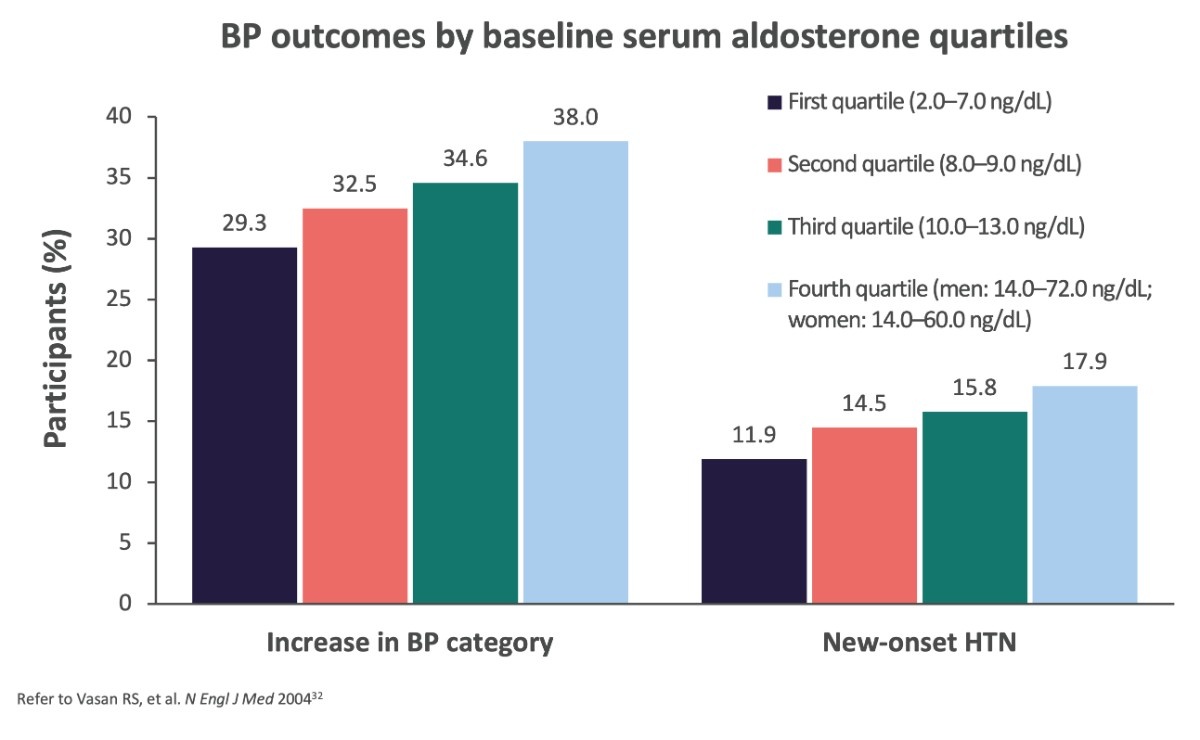
In the Framingham Offspring Study, 33.6% of participants experienced an increase in blood pressure category, and 14.8% developed new-onset hypertension, over 4 years.
The highest serum aldosterone quartile, relative to the lowest, was associated with a risk of an
elevation in blood pressure and risk of hypertension. In multivariable models, a 16% increase in the
risk of an elevation in blood pressure (P=0.002) and a 17% increase in the risk of hypertension
(P=0.03) were observed per quartile increment in the serum aldosterone level (Figure 3).32,e
Framingham Offspring Study on Raising Blood Pressure

Figure 3. Framingham Offspring Study highlights how higher aldosterone levels are associated with an increased risk of rising blood pressure categories and new-onset hypertension32

BP, blood pressure; HTN, hypertension.

Beyond absolute levels, increased aldosterone activity correlates with hypertension severity: across all blood pressure categories, a continuum of renin-independent aldosterone production has been observed, with higher aldosterone production associated with more severe blood pressure elevations33 (learn more about renin-independent aldosterone production in Module 3). This continuum suggests that aldosterone plays a pathophysiologically relevant role across the spectrum of hypertension, extending beyond conditions traditionally associated with aldosterone, such as classical primary aldosteronism.33
Importantly, recent real-world evidence shows that clinically relevant aldosterone dysregulation (defined as abnormal aldosterone production despite excess sodium and fluid in the body31–33) can occur at lower aldosterone levels than previously recognised, particularly in the presence of low renin activity (see Module 3 for a deeper exploration of the continuum of aldosterone dysregulation). Even modest elevations in plasma aldosterone (≥5 ng/dL [5000 pg/mL]) were associated with a significantly higher likelihood of uncontrolled hypertension, with increasing aldosterone levels conferring progressively greater risk. Elevated aldosterone levels (≥10 ng/dL) were also linked to a higher risk of CKD, reinforcing the contribution of aldosterone dysregulation to both difficult-to-control blood pressure and downstream cardiovascular and kidney risk.34,f
Importantly, recent real-world evidence shows that clinically relevant aldosterone dysregulation (defined as abnormal aldosterone production despite excess sodium and fluid in the body31–33) can occur at lower aldosterone levels than previously recognised, particularly in the presence of low renin activity (see Module 3 for a deeper exploration of the continuum of aldosterone dysregulation). Even modest elevations in plasma aldosterone (≥5 ng/dL [5000 pg/
mL]) were associated with a significantly higher likelihood of uncontrolled hypertension, with increasing aldosterone levels conferring progressively greater risk. Elevated aldosterone levels (≥10 ng/dL) were also linked to a higher risk of CKD, reinforcing the contribution of aldosterone dysregulation to both difficult-to-control blood pressure and downstream cardiovascular and kidney risk.34,f
Together, these findings illustrate how elevated aldosterone levels are relevant in hypertension, including uncontrolled hypertension. The consideration of aldosterone-related pathophysiological mechanisms is especially important when managing patients who remain uncontrolled, despite best efforts to reach blood pressure goals.12,35,36

WATCH

A Historical Overview of the Clinical Evolution of Aldosterone
Join Dr Raymond Townsend as he explores the history of aldosterone and the evolution of its clinical significance

Ready to learn more about how excess aldosterone contributes to cardiovascular and kidney damage?

Module 1 has focused on
aldosterone as an underlying, under-recognised driver
of elevated blood pressure and difficult-to-control hypertension. However,
aldosterone’s impact extends
beyond blood pressure alone.
How aldosterone acts directly on
the vasculature, heart and kidneys
to drive
end-organ injury is explored in Module 2.
Next Module

  1. a

    This real-world evidence study included data from patients diagnosed with hypertension between 2018-2023 in Israel, Spain, UK and US. The population percentage of patients who were uncontrolled were 75% in the UK, 69% in the US, 47% in Spain and 32% in Israel.11

  2. b

    Real-world study in 323,664 patients with diagnoses of hypertension with two or more anti-hypertensive medications between 2018 and 2023.20

  3. c

    Data from a cohort study that included 470,386 patients observed up to December 2010. The study included a total of 60,327 patients with resistant hypertension.22

  4. d

    Information from a study which included 948 adults from MESA (Multi-Ethnic Study of Atherosclerosis), a multicentre, longitudinal cohort study. Patients were recruited from 2000 to 2002 with a follow-up through July 2015.31

  5. e

    Data from the Framingham Offspring Study to investigate the relation of baseline serum aldosterone levels to increases in blood pressure and the incidence of hypertension after four years in 1,688 non-hypertensive patients.32

  6. f

    Data were obtained from patient plasma aldosterone measurements obtained during 2013-2023 in US electronic medical records (n=1334).34

  1. NCD Risk Factor Collaboration (NCD-RisC). Lancet 2021;398:957–980
  2. WHO. Global report on hypertension 2025. Available at https://www.who.int/publications/b/81068 (Accessed April 2026)
  3. Zhou D, et al. Sci Rep 2018;8:9418
  4. Lai Y, et al. Frontiers 2025;13:1503837
  5. Hanratty R, et al. Clin J Am Soc Nephrol 2011;6:2605–2611
  6. World Heart Federation. World Hypertension Day: Taking action against the silent epidemic of high blood pressure. Available at: https://world-heart-
    federation.org/news/world-hypertension-day-taking-action-against-the-silent-epidemic-of-high-blood-pressure/
    (Accessed April 2026)
  7. Sarafidis PE, et al. Am J Med 2008;121:332–340
  8. Rapsomaniki E, et al. Lancet 2014;383:1899–1911
  9. Mancia G, et al. J Hypertens 2023;41:1874–2071
  10. Visco V, et al. J Hum Hypertens 2018;32:467–476
  11. McCormack T, et al. Presented at ESC, 28–31 August 2025. Madrid, Spain
  12. Viera AJ, et al. Am Fam Physician 2009;79:863–869
  13. McEvoy JW, et al. Eur Heart J 2024;45:3912–4018
  14. Alsharari R, et al. J Hum Hypertens 2022;36:337–340
  15. Prejbisz A, et al. Kardiol Pol 2025;83:370–411
  16. Million Hearts.® Estimated Hypertension Prevalence, Treatment, and Control Among U.S. Adults. Available at: https://millionhearts.hhs.gov/data-reports/
    hypertension-prevalence.html
    (Accessed April 2026)
  17. Molina de Salazar DI, et al. Am J Cardiovasc Drugs 2024;24:197–209
  18. Al-Dalakta A, et al. Cleve Clin J Med 2025;92:555–564
  19. Taderera BH. Healthcare 2025;13:2267
  20. McCormack T, et al. J Hypertens 2025;43(Suppl 1):58
  21. Ma J, Chen X. Front Cardiovasc Med 2022;9:1003852
  22. Sim JJ, et al. Kidney Int 2015;88:622–632
  23. Ojha U, et al. Am J Cardio Drugs 2022;22:271–285
  24. Strizzi CT, et al. Int J Mol Sci 2025;26:8829
  25. Bioletto F, et al. Int J Mol Sci 2022;23:4803
  26. WHO. Sodium reduction. Available at: https://www.who.int/news-room/fact-sheets/detail/sodium-reduction (Accessed April 2026)
  27. Schweda F. Pflugers Arch 2015;467:565–576
  28. Chen L, et al. Horm Metab Res 2024;56:99–106
  29. Verhovez A, et al. Curr Signal Transduc Ther 2012;7:132–141
  30. Brown JM. J Am Heart Assoc 2024;13:e030142
  31. Inoue K, et al. Hypertension 2020;76:113–120
  32. Vasan RS, et al. N Engl J Med 2004;351:33–41
  33. Brown JM, et al. Ann Intern Med 2020;173:10–20
  34. Townsend RR, et al. Am J Hypertens 2026;39:161–170
  35. Bakris G, et al. J Clin Hypertension 2023;25:737–747
  36. Stevens TM, et al. Ann Hypertens 2018;1:1005

Types Of Difficult-to-Control Hypertension Infographic

Overcoming Barriers To Optimal Hypertension Management Infographic

Framingham Offspring Study on Raising Blood Pressure
AstraZeneca Logo
Cookie Policy Legal Notice and Terms of Use Privacy Notice Contact Us Report Adverse Events

©2026 AstraZeneca. All rights reserved. Z4-80196 Last Updated May 2026

Module Contents
The Growing Global Burden of Hypertension
Challenges of Uncontrolled Hypertension
Consequences of Uncontrolled Hypertension
Complex Pathophysiology of Hypertension
Aldosterone: Adaptive and Maladaptive Roles
Aldosterone and Hypertension Risk

Think Aldo logo image

Welcome to Think Aldo

Welcome to Think Aldo, an expert-led initiative advancing knowledge and science around an often overlooked driver of hypertension and cardiovascular and kidney disease: aldosterone.1,2

This website provides the latest scientific insights and educational resources, curated by a network of experts, and is intended for healthcare professionals.

Are you a healthcare professional?

I am not a healthcare professional I am a healthcare professional

This non-promotional medical education website has been developed by AstraZeneca and is intended for healthcare professionals outside of the US.
 

References
1 Papadopoulou-Marketou N, et al. Hyperaldosteronism. In: Endotext [Internet]. South Dartmouth (MA): MDText.com, Inc. 2000
2 Vaidya A, et al. Am J Hypertens 2022;35:967–988
AZ-logo
Legal Notice and Terms of Use Privacy Notice Contact Us Report Adverse Events

©2026 AstraZeneca. All rights reserved. Z4-80196 Last Updated May 2026